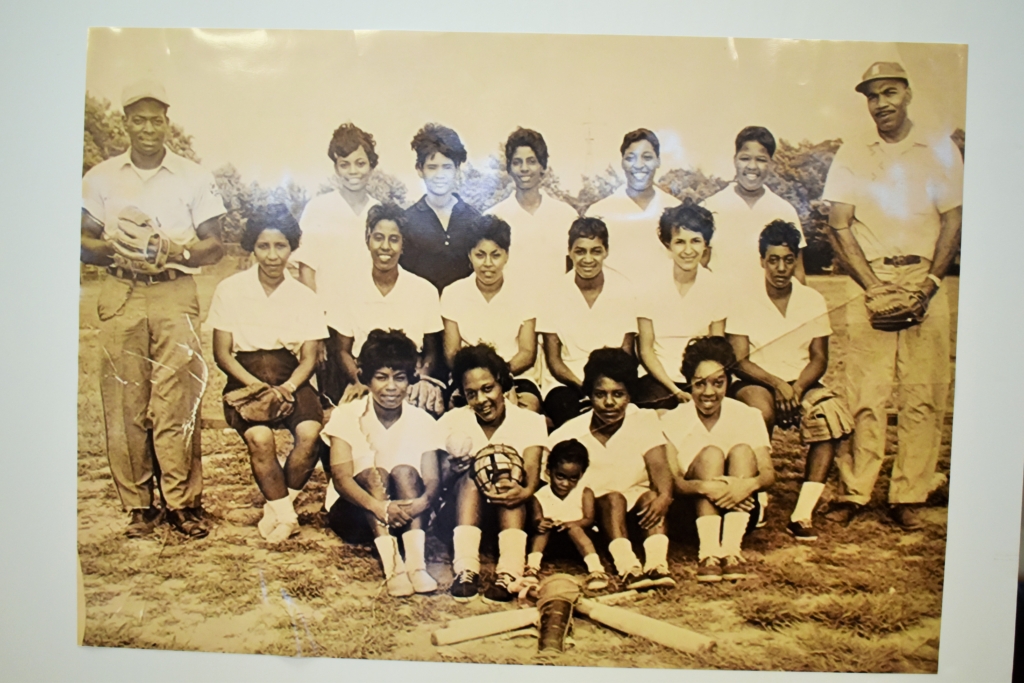
During the late 1940s, a group of young women ahead of their time decided they wanted to play softball, even if it meant playing on a makeshift ballfield dubbed the Dust Bowl behind the F.C. Kerbeck car dealership on Route 73.
“We would get scratched up retrieving a foul ball that went into the blueberry patch,” full of thorns and sharp twigs, remembered 91-year-old Mary Holloway. “We had to because we only had one ball.”
With the help of Kenny Still, Holloway and five friends recruited more players and formed the Diamond Daisies fast-pitch softball team.
“We played different towns and we were pretty good,” Holloway remembered.
Although there was no formal league, the competition was real. When the women’s softball league officially opened in the 1950s, the young ladies formed the Majestics and asked Osa Meekins to be their manager.
“Sure,” said the legendary Palmyra baseball and football coach. “But, I want everybody to be dedicated.”
Meekins and assistant coaches Alfred Dorsey and Mickey Boroughs taught the ballplayers from West Palmyra the fundamentals of a winning team – great pitching, great defense and timely hitting. The Majestics indeed were dedicated, and became great players on one the best teams in the state.
“We won a big tournament in North Jersey,” recalled Holloway during Palmyra’s Black History presentation on Feb. 20 at the community center.
Facilities coordinator Michele Sykes, who organized the presentation, noted that she had never heard of the two softball teams and thought it would be a great topic after further research.
“During the 1940s and ’50s, there was silent segregation, and social barriers existed,” she explained at the Black history event. “These players broke through those barriers. They practiced several days a week. Every player was already a star athlete or ready to be one.
“We are gathered here today to honor these women,” Sykes told the presentation attendees. “Their impact lives on with the foundation of this community – the ability to live and raise children in the same town as their moms and grandmoms.”
Majestics stars Buroughs and Holloway went on to be the only two African American players on an all-white, semi-pro team, breaking down another barrier.
“When Michele mentioned this presentation, I thought it was just fantastic,” Mayor Gina Ragomo Tait said to the audience, adding that Palmyra is a multi-generational town and it is important to inform people about its history.
On opening day of the softball season this spring, the borough will officially dedicate the Legion Softball Field to the Diamond Daisies and the Majestics.
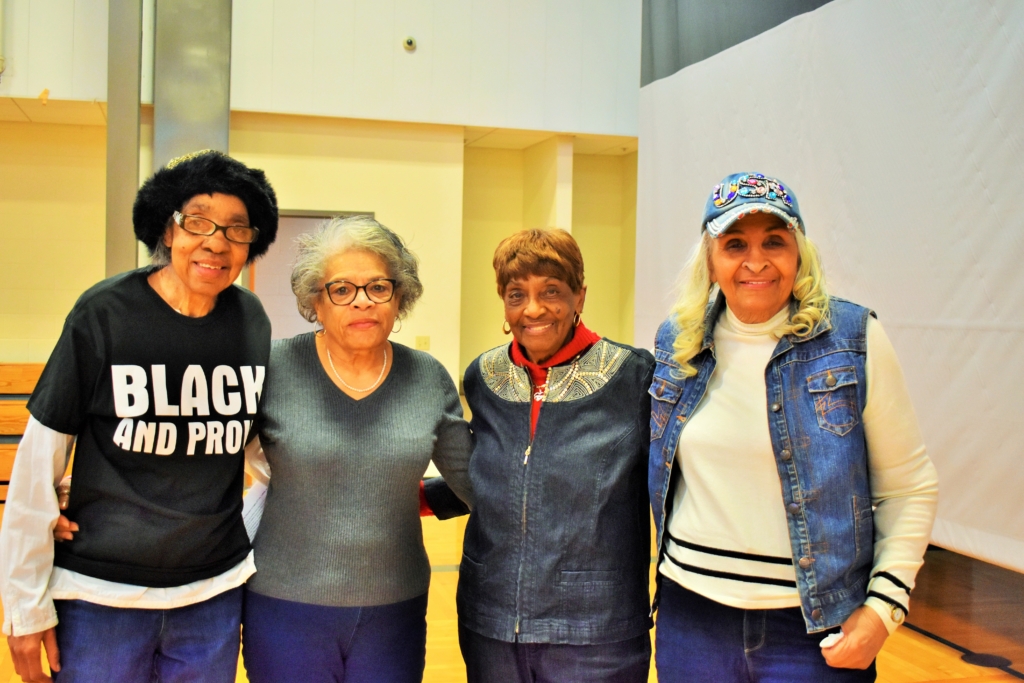
Also enjoying the Black History presentation and reminiscing about their experiences playing softball with the Majestics were three of Holloway’s surviving teammates, Hettie Hunt, Thelma Scott and Buroughs.
“We love it,” said Buroughs, who praised Coach Meekins for making them better players and keeping them focused. “We all played ball.
“We had fun, but we got down to business on the field.”
“We had a good time,” added Hunt, who wore a sweatshirt with the words “Black and Proud” emblazed on the front. “When we won, that was really good.”
All four women said they appreciated the support of the community and sponsors, who made sure the team had bats, gloves, uniforms and more than one softball.
“We did have uniforms,” Buroughs said. “Back in the day we wore skirts.”
“We looked good,” Holloway followed, “and we won a lot of games. We loved to play Trenton because there would be a barbecue after the game.
“We had a lot of fun.”
The Majestics even had their own public relations specialist. “Everyone in Palmyra knew when we had a home game,” said Holloway, pointing out that teammate Elaine Myers-Brown would go around town with a bullhorn at 3 p.m. announcing that the game would begin at 6 p.m.
This season the next generation of Palmyra softball stars will get to play on the Diamond Daisies/Majestics Softball Field at the Legion Sports Complex, where the legacy of great softball players of the past will live on forever.
Their names include Hettie Hunt, Jerolyn Boyd-Washington, Quinn Myers, Barbara Hyman, Helen Ganges, Yvonne Buroughs, Mary Austin Holloway, Sandy Person, Katherine Jones Pratt, Elaine Myers-Brown, Lucille Boyd Jones, Marilyn McCombs, Doris Gaines Langston, Agnes Gaines, Ann Johnson Hyman, Margie Pratt-Butler and Thelma Johnson Scott.