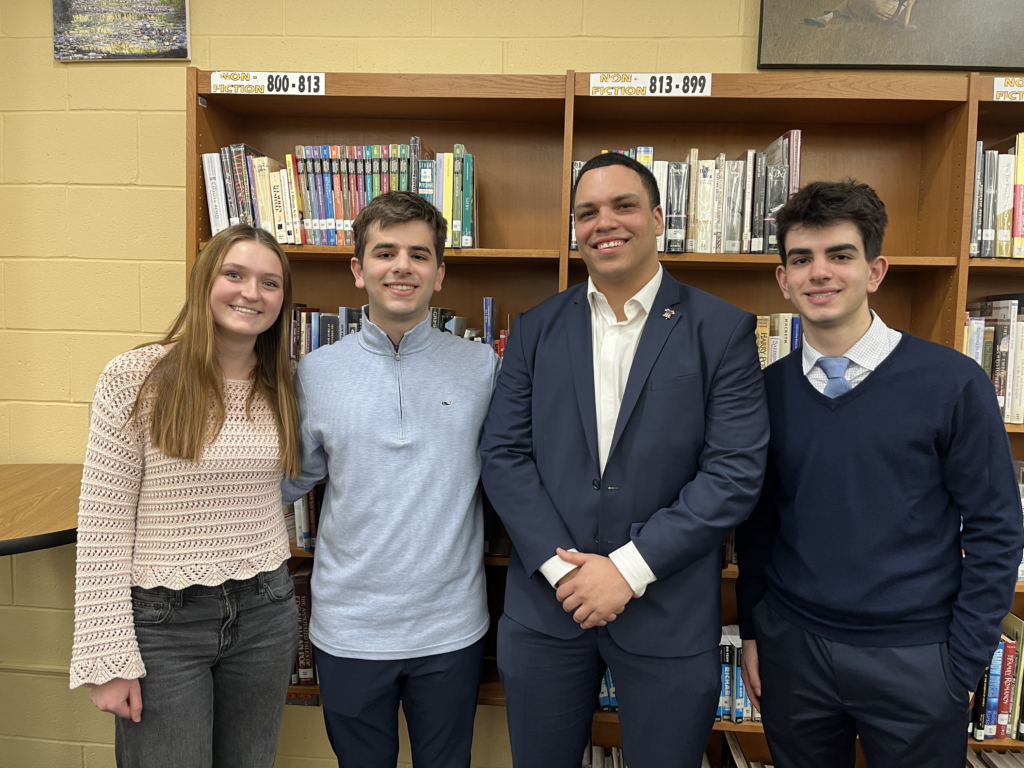
Moorestown High School junior Kaitlyn Muhic (left to right), senior Angelo Boujaoude, Mayor Quinton Law and sophomore Sandro Boujaoude marked February’s Black History Month with a talk from Law, the township’s first African American mayor.
Mayor Quinton Law met with high-school students on Feb. 4 to discuss his path into public service and reflect on his time at Moorestown High.
The school’s Cultural Crossroads and Young Historian’s clubs helped organize the event, which coincided with February’s Black History Month.
“It was truly inspirational to hear someone share their experiences growing up in Moorestown, and how their different cultural background and diversity were able to shape them into who they are today, and positively impact our community,” said Angelo Boujaoude, president of the Cultural Crossroads Club.
“The most inspirational part about it is seeing someone who comes from our own school come and speak with us and share his experiences,” noted Sandro Boujaoude, vice president of the club, “and how he came to a point where he could run and become the first African American mayor of Moorestown.
“I think that was definitely a very transformative experience for me.”
“I thought it was amazing to have a mayor who cared enough to come out to talk to our high school, where he used to go, and tell people about his journey, and really inspire others for the future,” observed junior Kaitlyn Muhic.
Law graduated from the high school in 2015 and earned a degree in economics, with a concentration in public policy, from Bryant University in Rhode Island. A third-generation Moorestownian, he was appointed to council in 2021, but made history last year when he became the township’s first Black mayor. Law is also a founding member of the Moorestown Alumni for Racial Equity and Inclusion (MAREI).
At Moorestown High, Law participated in football, basketball, lacrosse and track, and was also involved in the Model Congress and the Future Business Leaders of America clubs. What the future mayor learned from all of that set him on the path to make his community – and the world – better places.
“There’s a lot of apathy out there – at least from my perspective – and my advice to you is, don’t follow that apathy,” Law shared with the students. “We can’t let our inability to change the world in one day or change the world even in one year stop us from doing something. Doing something is quite literally the only thing that’s ever made change happen in the world.”
Law also suggested the students not let their inability to do everything stop them from doing something, and that they understand the concept of delayed gratification. As a student, Law thought about networking as a linear thing, but what he failed to realize was that it’s different from what he originally thought.
“A lot of networking is actually horizontal,” he explained. “It’s the people that you’re currently in class with now, the people that are going to go on to do very great things … You have to realize how lucky you are, no matter where you come from, who your parents are, that you get access to this public education …
“We get education at the public level that is higher than most places in most states, and we’re incredibly lucky for that. Build the relationships now.”
Law encouraged seniors to maintain their relationships with peers as they prepare to embark on a new chapter in a few months. Before his election to council, Law noticed how other young leaders all over the country were standing up in their communities, fighting for change, representation and diversity. That made look at his own community.
Having a young person’s voice on council and having the voice of an underrepresented community was needed at the time that he ran, Law shared.
“In a time when trust in government and political apathy is at its highest, I try to be a steady hand in that environment and show that, when you elect people who prioritize people over politics, even if they’re young, good things can happen,” he related.
“ … You seeing me up here as a young person,” Law added. “I hope that inspires you to get involved in your community, and it shows you that we do have a voice. People will listen …
“The moment we give up is the moment we lose everything, and we can’t lose everything.”

