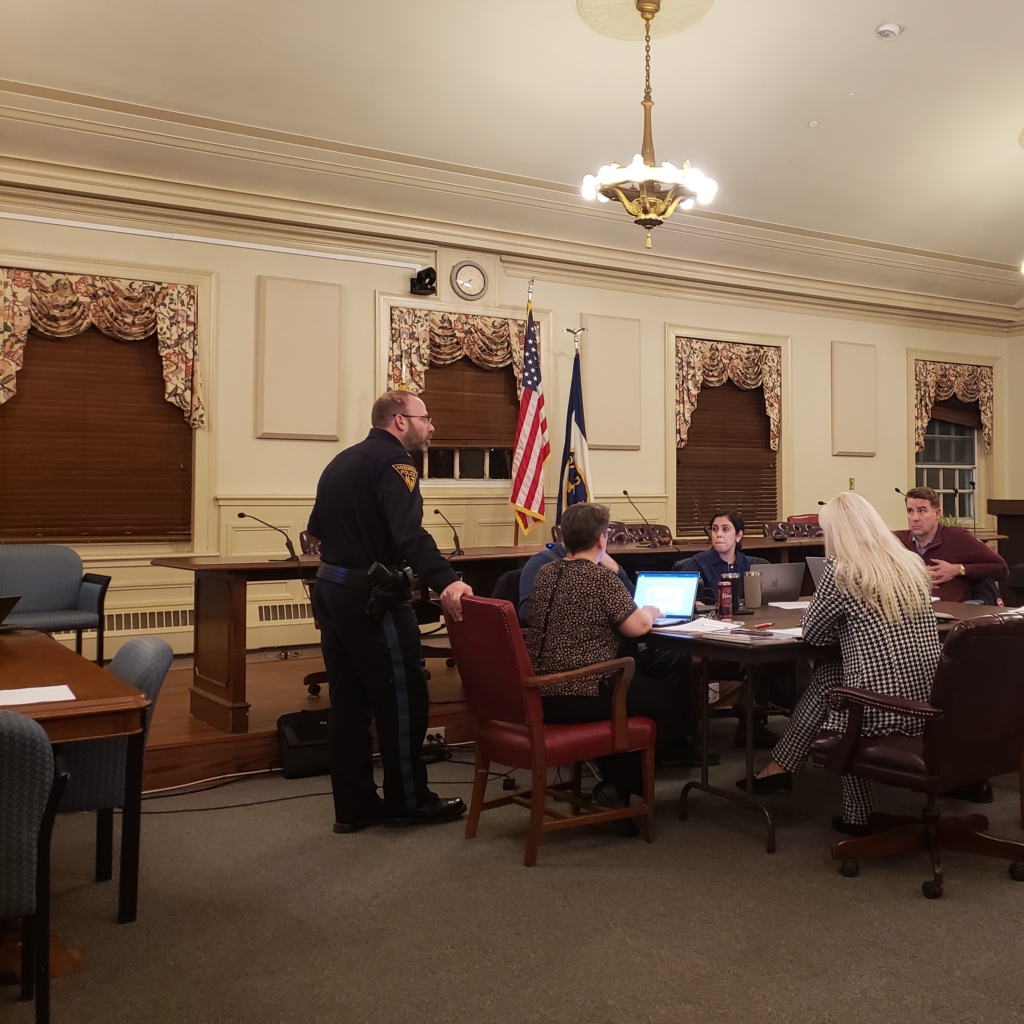
Police Chief Jason Cutler discussed the issue of possible ICE interactions at a recent meeting of borough commissioners.
What happens if ICE shows up in Haddonfield?
“This idea that it can’t happen here is a very privileged and unrealistic expectation to take,” a concerned resident told the borough’s board of commissioners at a recent meeting. “If there are children walking around, my kids, their friends, whoever. Do we have a position in town on how we want our children to respond?”
The scenario came up at the commissioners’ meeting in the aftermath of the Jan. 7 shooting death of Renee Good by an ICE officer in Minneapolis, the circumstances of which remain hotly debated around the country. Each borough commissioner offered an opinion on what might happen if ICE came to town.
Mayor Dave Siedell has told his own children to comply with all law-enforcement officials and not escalate a similar situation.
“So, I told my children, (say) I don’t have ID, I’m an American citizen,” he acknowledged. “That’s all I ever tell them to say. But comply? Sure. Always told my children, nothing can be solved in the moment, but it can be solved, right. So unfortunately, you have to sometimes comply …
“Nothing gets solved in the moment when passion is high, so comply.”
The citizen who addressed commissioners – and asked to remain anonymous – responded that he thinks it’s too late for the kind of mentality advocated by the mayor.
“My observation with my eyes and with my ears is that we’re kind of beyond that,” the resident related, “and this is new territory for everybody. So if this is like, ‘Hey handle it in your house the way you want to handle it, family to family,’ no problem.”
An October report by ProPublica, a group of investigative reporters, showed that in the first nine months of Donald Trump’s second term, his administration has detained more than 170 American citizens, around 20 of whom are children. The American Immigration Council reported in January that of the approximately 66,000 total individuals in ICE detention at the end of 2025, 41% have no criminal record.
The ICE issue prompted an opinion from Commissioner Frank Troy that Haddonfield has a “low-risk profile,” with an ICE situation unlikely.
“I view everything through like a risk profile,” he explained. “What is the risk and probability? … What is the probability of risk in Haddonfield? It’s very low given the fact that – the likelihood of it happening is very low – so should you draw attention to it or should you leave it to parents that have discussions with their kids?”
Troy noted that he based his risk profile on “the targets that ICE and other people are going after.” In a later interview, he clarified that his notion of low risk is based on the small, foreign-born population in Haddonfield of just 545 people, 470 of them citizens. That amounts to just 4.4% of the total population in 2023.
The anonymous resident didn’t agree with him.
“I would hope the official statement wouldn’t just be, ‘We’re Haddonfield, this doesn’t happen here,'” the person said.
Commissioner Itir Cole also said she would urge her children to deescalate a potential situation with ICE or other law-enforcement agencies.
“I tell them, ‘We protect each other, we protect our neighbors, but we deescalate,” Cole stated. “When these folks are showing up, they’re showing up with weapons, and they’re showing up already agitated … I would position myself in a way where I could deescalate the charged environment and see if I can protect my neighbors.”
Meanwhile, there are already state guidelines on the books on what to do in an ICE situation, according to Police Chief Jason Cutler. The borough is expected to abide by a 2018 Immigrant Trust Directive from the attorney general that outlines how local police should and shouldn’t interact with ICE. It prevents law enforcement from detaining people based solely on their immigration status and disallows the use of local police resources by ICE.
Administrator Sharon McCullough said there hasn’t been an official notice from the borough on what residents should tell children about interactions with ICE or other law enforcement.
“I don’t think there has been a discussion, is the answer right now,” she pointed out. “And I think what we can do moving forward is have a conversation with the schools and the commissioner of public safety and determine if there’s something that we do want to put out officially for those as long those to pass onto the kids.”
Siedell brought up an ICE case that has already had a local impact: The arrests of Jersey Kebab owners Emine and Celal Emanet after a raid of their Haddon Township restaurant on Feb. 25. An ICE spokesperson said the two Turkish citizens, who came to the U.S. in 2008, were here illegally.
While Celal was released from custody with an ankle monitor, his wife remained in ICE custody for two more weeks. The couple eventually reopened their eatery in Collingswood in October, but their legal status remains uncertain.
The anonymous resident referred to the Emanets while expressing concern about a possible ICE presence in town.
“Not everybody in town looks like us, guys,” the resident observed. “We can all acknowledge that, right? So if, again, it’s so far past political, I’m just talking strictly (standard operating procedure). What do we want to tell the children to do? The same way we’d tell them what to do in a fire, right, we have fire drills in school …
“What do we tell our kids so they don’t get themselves in trouble? So they don’t get themselves accidently hurt.”
Siedell said he appreciated the resident coming forward. The board further discussed the issue in closed session after the public work session, but no action was taken.

